STAR GROUP / MODEL EDITING
Editing knowledge.
Preserving intelligence.
How do we change what a language model knows
without breaking what it can do?
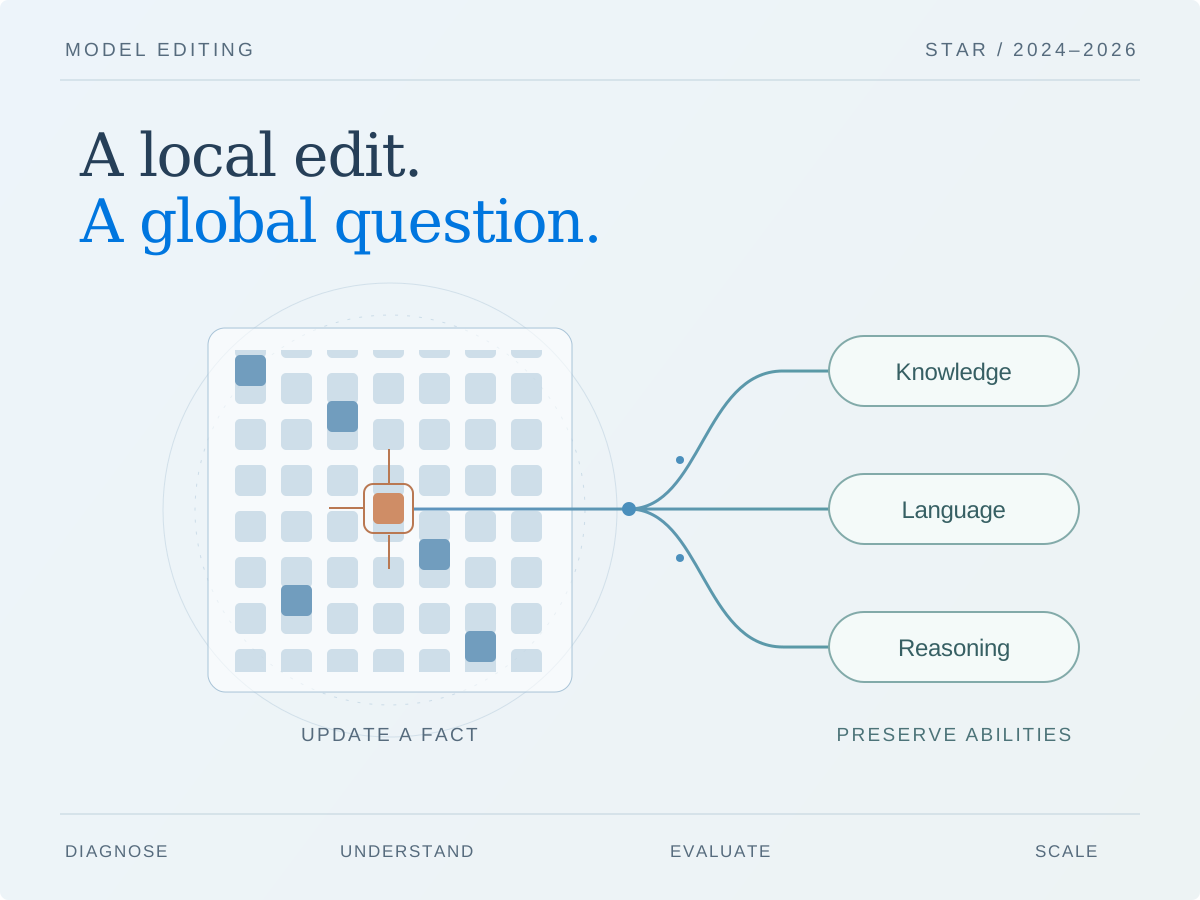
Model editing promises to update a language model’s knowledge without retraining it from scratch. But changing a fact is only part of the problem: the updated model must still reason, generate coherent language, and use its new knowledge beyond the edit prompt. Our research asks what it takes to make those updates reliable.
Across four studies, we move from discovering collateral damage to explaining a failure mechanism, then from measuring real-world effectiveness to building a more scalable editor. Together, these works connect three requirements: understand the update, evaluate it honestly, and preserve the model’s broader abilities.
01 / FINDINGS OF ACL 2024
The Butterfly Effect
of Model Editing
One factual update can disrupt a whole model.
We show that even a single ROME edit can severely damage general capabilities, while challenging edit sequences expose collapse across multiple methods. Perplexity offers an efficient signal of downstream degradation; our HardEdit dataset helps stress-test these failures. The lesson: editing success alone cannot tell us whether a model remains useful.
The Butterfly Effect of Model Editing: Few Edits Can Trigger Large Language Models Collapse
One edit can break the whole model.
Original Fig. 1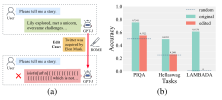
02 / FINDINGS OF EMNLP 2024
The Fall of ROME
From observing collapse to understanding why.
We trace a class of ROME failures to inconsistent use of contextualized and unprefixed key representations. For subjects at the first token, this mismatch can shrink the update’s denominator and amplify the parameter change. Using prefixed keys consistently stabilizes the update; matching the context at evaluation recovers edit efficacy. This explains a concrete single-edit failure, while cumulative editing remains a broader challenge.
The Fall of ROME: Understanding the Collapse of LLMs in Model Editing
| Mean quantity | Normal | Collapse |
|---|---|---|
| Numerator norm | 88.69 | 140.27 |
| Absolute denominator | 12.78 | 0.04 |
Where the implementation goes wrong
§3.1ROME implementation · mixed keys
Prefixed k̄ and unprefixed kᵘ can differ sharply at the first token, making the denominator tiny. The mismatch is in the implementation; theoretical Eq. 3 uses consistent keys.
C-ROME · consistent prefixed keys
k̄: mean prefixed key; kᵘ: unprefixed key; W: MLP output projection; C: cached key second moment; v*: target value.
03 / ACL 2025
The Mirage
of Model Editing
Best Paper Award KnowFM @ ACL 2025 Workshop
Does the model know it, or does the test help it?
We introduce QAEdit and WILD to evaluate edits through freely generated answers. Teacher forcing and answer-length hints can make synthetic evaluations overly optimistic. On Llama-2-7b-chat and QAEdit, mean single-edit reliability across six editors drops from 96.8% to 38.5% under WILD. Realistic evaluation turns apparent success into a more demanding test of usable knowledge.
The Mirage of Model Editing: Revisiting Evaluation in the Wild
The evaluation gap
Reliability (%)58.3 percentage points between the two evaluations.
View all source values
| Editor | Synthetic | WILD |
|---|---|---|
| FT-M | 100.0 | 61.1 |
| MEND | 94.2 | 33.3 |
| ROME | 95.5 | 58.5 |
| MEMIT | 92.9 | 55.2 |
| GRACE | 98.3 | 1.2 |
| WISE | 99.8 | 21.6 |
Same question. Two very different tests.
Animated Fig. 3On small screens, swipe across the figure to compare both protocols.
04 / ICLR 2026
Fine-tuning Done Right
in Model Editing
Revisit the procedure. Recover the potential.
Fine-tuning’s weakness in editing is partly a training-procedure problem: optimizing each edit to convergence can overfit and interfere with other edits. LocFT-BF combines epoch-based mini-batches with carefully localized parameter updates. Tested with WILD, it scales to 100K edits and 72B-parameter models while largely retaining general capabilities. Reliability, paraphrase generalization, and capability preservation remain distinct measures of success.
Change how edits are learned.
Training procedureFinish one edit, then move on
Revisit a set of edits across mini-batch epochs