KNOWLEDGE BOUNDARIES & UNCERTAINTY
From latent knowledge
to reliable answers.
Why capable models still get facts wrong—and what it takes to make their answers trustworthy.
A model may know more than it can reliably express, yet be confident about answers that are wrong. Correct answers can hide in the low-probability tail; mistakes can be repeated consistently. External evidence adds another challenge: a model can overlook the right information or be diverted by misleading context.
We study the journey from knowledge to reliable answers: improving factual recall, assessing uncertainty at the right granularity, and learning how to use evidence or withhold an answer. These are complementary research directions, each addressing a different gap between a model’s capabilities and its behavior.
THE STARTING POINT
When certainty misleads.
Consistent answers and convincing context can both point in the wrong direction.
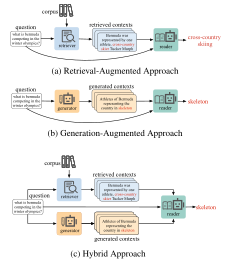
Blinded by Generated Contexts: How Language Models Merge Generated and Retrieved Contexts When Knowledge Conflicts?
More context can make an answer worse.
When generated and retrieved passages conflict, models often favor generated text—even when it is wrong. Our controlled study examines the roles of question similarity and semantic completeness. The preference persists when generated text conflicts with the model’s parametric knowledge, revealing a source-selection problem beyond simply trusting familiar facts.
Too Consistent to Detect: A Study of Self-Consistent Errors in LLMs
We identify wrong answers that stay semantically unchanged across repeated samples. These errors persist as models grow in our experiments and challenge several kinds of detectors. Cross-model hidden-state evidence helps expose blind spots that the answering model’s own signals can miss.

01 / ACCESS
Knowledge can be present,
yet hard to reach.
A failed recall is an observation about an answer—not a complete inventory of what a model knows.
Beyond Reasoning: Reinforcement Learning Unlocks Parametric Knowledge in LLMs
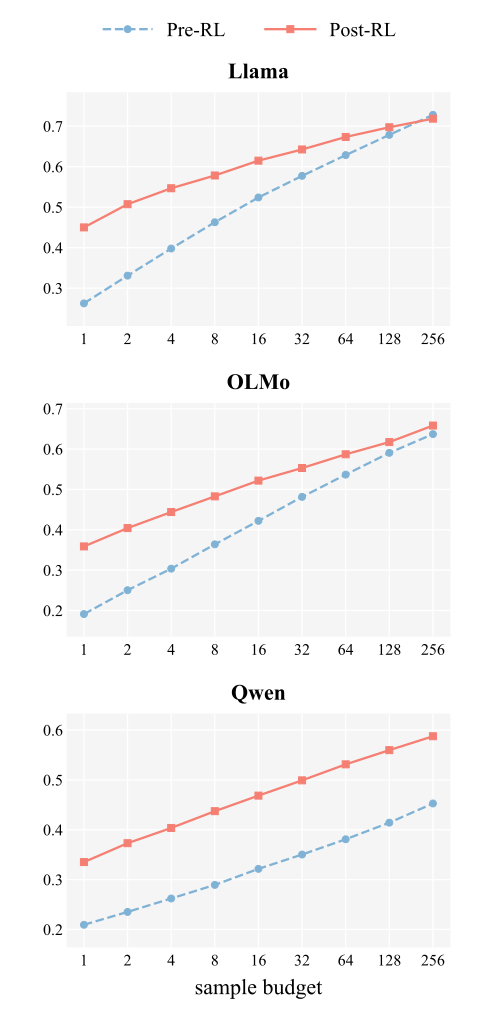
In one-hop, closed-book QA without explicit chain-of-thought, correctness-reward RL makes factual knowledge easier to recall. Fact-level train–test deduplication and sampling analyses support a shift in accessibility: correct answers move from the low-probability tail toward reliable output. When correct answers are too rare to reinforce, gains remain limited.
RL changes how easily the correct answer can be reached.
pass@k means at least one correct answer within k samples; it is not majority-vote accuracy. Pre-RL models are the starting instruction-tuned checkpoints. The curves support improved accessibility rather than directly measuring stored knowledge. Each panel keeps its original y-axis range; the sample-budget axis is shared.
02 / ASSESS
Give confidence something
meaningful to say.
Three complementary questions: what to align, where to look, and how finely to judge.
ALIGNMENT
When to Trust LLMs: Aligning Confidence with Response Quality
CONQORD combines a response-quality reward with an order-preserving confidence reward. It encourages higher-quality answers to carry greater stated confidence, while discouraging low-quality, low-confidence shortcuts. The calibrated signal can also guide whether to retrieve external knowledge.
R = Rquality + α Ralignment
REFERENCE SIGNALS
BaseCal: Unsupervised Confidence Calibration via Base Model Signals
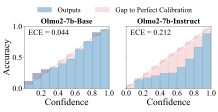
Post-training can leave confidence less well calibrated. BaseCal uses the corresponding base model as a reference: by rescoring answers, or by learning a lightweight projection toward base-model representations. The answering model stays unchanged, and the projection requires no human correctness labels.
GRANULARITY
Fact-Level Calibration and Correction for Long-Form Generations
The boundary can run through a single answer.
A long response can mix reliable and unreliable claims. Our framework examines confidence alongside each fact’s correctness and relevance. CARE uses higher-confidence facts to help refine lower-confidence ones, turning a coarse judgment about an answer into targeted correction.
“Deep Blue was aGochess computer developed by IBM that defeated Garry Kasparov in 1997.”
03 / ACT
Make the response a choice.
Use helpful evidence, resist interference, and retain control over which answers are given.
Knowledgeable-R1 jointly trains parametric, context-aware, and robust-parametric views of the same question. Comparing their rewards helps the model use beneficial evidence and resist misleading context. The learned policy encodes knowledge use without an explicit inference-time confidence gate.
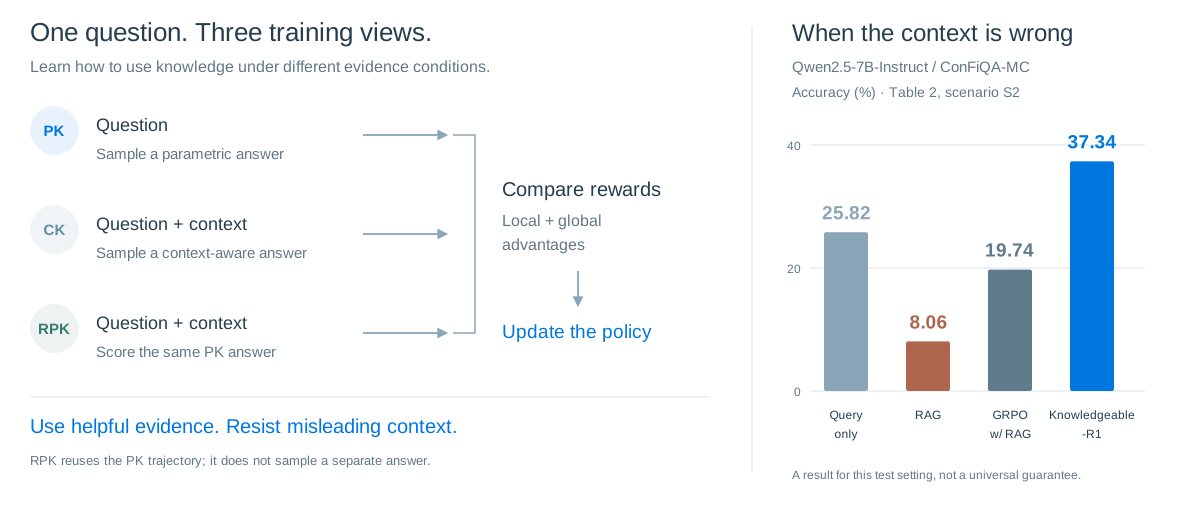
Swipe to compare the training views and the experimental result.
Strong yet Controllable LLM Abstention without Learning to Abstain
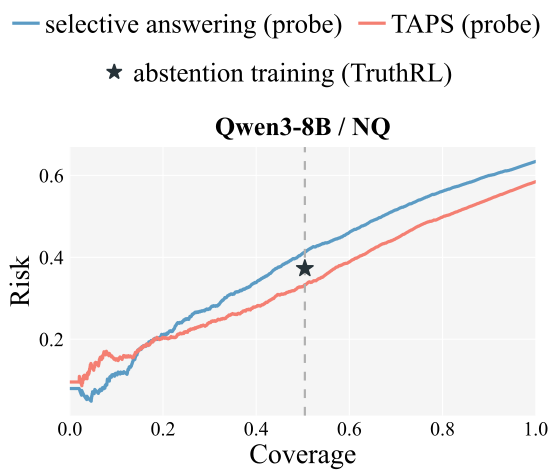
TAPS separates training for accurate answers from selecting which answers to give. A confidence threshold preserves control over coverage, while matched-coverage evaluation distinguishes answering gains from better rejection decisions. It needs no dedicated abstention objective; accuracy training and a probe can still require training.
Explore the TAPS project ↗How much should a model answer?
Coverage is the fraction of questions answered; risk is the error rate among those answers. Drag the slider to compare methods at the same answer rate. The curves sweep operating points; each abstention-trained model has a fixed point.
PUBLICATIONS & RESOURCES
The papers behind this research.
-
ACL 2024 · Published conference paper · doi:10.18653/v1/2024.acl-long.337
-
Too Consistent to Detect: A Study of Self-Consistent Errors in LLMs
EMNLP 2025 · Published conference paper · doi:10.18653/v1/2025.emnlp-main.238
-
Beyond Reasoning: Reinforcement Learning Unlocks Parametric Knowledge in LLMs
arXiv 2026 · Preprint · doi:10.48550/arXiv.2605.07153
-
When to Trust LLMs: Aligning Confidence with Response Quality
Findings of ACL 2024 · Published conference paper · doi:10.18653/v1/2024.findings-acl.357
-
BaseCal: Unsupervised Confidence Calibration via Base Model Signals
ACL 2026 · Published conference paper · doi:10.18653/v1/2026.acl-long.234
-
Fact-Level Calibration and Correction for Long-Form Generations
SIGIR 2025 · Published conference paper · doi:10.1145/3726302.3730195
-
Resisting Contextual Interference in RAG via Parametric-Knowledge Reinforcement
ICLR 2026 · Published conference paper
-
Strong yet Controllable LLM Abstention without Learning to Abstain
arXiv 2026 · Preprint · doi:10.48550/arXiv.2610.16318